


Background: La Cage aux Folles
Jean Poiret wrote La Cage aux Folles in 1973 and that same year it was premiered in a famous Théâtre du Palais-Royal in Paris. The play was later made into a film by the name of La Cage aux Folles, with the literal translation being „The Cage of the Madwomen. In 1983, a very successful musical was staged on Broadway. La Cage aux Folles belongs to the pinnacle of the boulevard comedy genre and provides an intriguing plot, classic comedy of confusion and picturesque characters. Filled with cliché turns of events enriched with a modern queer twist, it balances humor and drama, which some might call predictable but still entertaining.
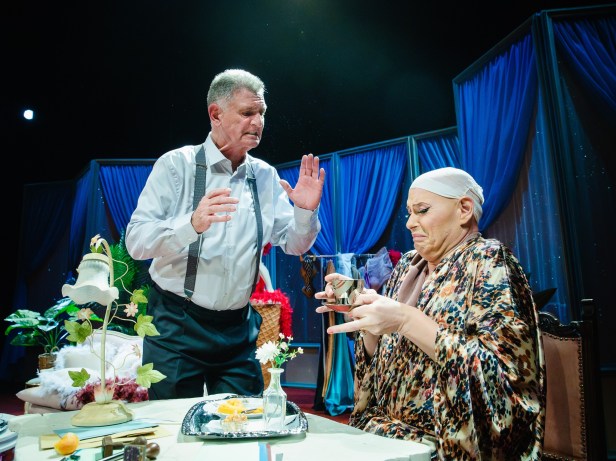
Krletka – adaptation in the Croatian National Theatre Varaždin
The director of the adaptation in the HNK (Croatian National Theatre) Varaždin, Krešimir Dolenčić used the original play La Cage aux Folles, as a skeleton around which the Croatian adaptation entitled “Krletka” was woven and reinvented in the process of staging. Remaking roles, inserting texts and adding allusions related to the small yet rich social environment of the Croatian north-west region enhanced the play’s wittiness, while relating to the audience with popular Croatian songs everybody loves singing along to. Not one word in the play was unfunny or dull, whether it was a pun directed to the residents of Varaždin or simply a word said with a perky accent, the theatre was echoing with laughter. The play called out homosexuals, heterosexuals, men, women, the rich, the poor; hence, no one was safe and yet no one was complaining. The controversial nature of the play’s topics sparked interest in many so the theatre is always packed. The play has gained popularity because Varaždin has never seen something like this before. Men prancing in skirts, pretending to be cats, singing and running a gay night club has never before been acted out in this rather close-minded milieu.

Stage design and plot
After its opening night on November 23rd 2024, Krletka caught the eye of many critics and professionals, mainly because of its simple yet memorable stage design. Two main scenes: one happening in the night bar sharing the same name as the play, and one happening “upstairs”, which represents the owner’s apartment. The club scene has a vintage tone, something out of a refined jazz club, yet more scandalous. Set with a wooden stage, decorated with simple curtains it allows entertainers to take the spotlight with their bright and revealing outfits and wigs. Keeping the same scandalous atmosphere, the upstairs apartment is filled with pink pillows, pink blankets, pink mirrors, pink clothes and even pink makeup, all related the protagonists of the play: Albin, recognized by her pink aura. In simple terms, Albin is the ultimate diva: she sings, wears feathers, takes time to finish getting ready, is quite motherly towards her step-son and her overall attitude makes her a dominant and unforgettable character. Her gender is undefined during the play, we aren’t sure if she is a cisman dressing up in drag or a transsexual. She is often reffered to as the “mother” and uses female pronouns. The actor does an amazing job at embodying an adult woman, despite being a straight man. Her homosexual relationship with Georges makes them a dynamic duo, given that Georges is less comfortable showing his feminine side, despite being gay he still has signs of toxic masculinity. After his biological son comes home with the news that he is marrying a woman, the greatest irony occurs: Georges is displeased with his son’s choice of liking women and even more enraged when he finds out the bride’s conservative family is coming to visit. Trying to hide his lifestyle as well as to impress his future in-laws once and forever, he struggles to maintain a good image in front of them which turns into an ironic and puzzling twist of events when he and Albin find out about the conservative family’s secrets.

Is Krletka an accurate queer representation?
Although Krletka is represented as a comedy with lighthearted themes, it unravels some serious issues about the modern world. All of the employed performers at the night club are closely associated with sex work, substance abuse and poor living conditions such as struggling family lives and money problems. Drag queens are often stereotyped and looked down upon because many are believed to be involved in illegal businesses. This stereotype is the farthest thing from the truth – drag is a form of art and it should not be related to the persons’ private affairs. People of all races, sexualities and lifestyles can be involved in illegal work. The play is performed in an environment where people are unfamiliar with the art of drag and see only the flamboyant and naïve caricatures, which might only misshape their pictures of real-life trans people. Georges, a character that is different from other queer representations in the play, shows that not all homosexuals are emotional, overexaggarated women-wannabes. Another problem is when Albin tries to convince the conservative family that she is a woman, she becomes weak and emotionally unstable, which is a common stereotype towards the female population. In my personal opinion, the play does its part on being a comedy, yet it doesn’t tackle the stereotypes drag queens and trans people are associated on a daily basis.
Written by Tia Marija Milak, Prva gimnazija Varaždin, Croatia
 News for YOUth
Excellent article about great theme. I really enjoyed reading this and this encouraged me to watch this show.
Nino Petek
LikeLike
Excellent analysis of the play’s complex role. Author perfectly captured its tricky balance: it’s a huge local success that uses humor to make queer themes accessible, which is significant. However, author’s critique is vital, especially regarding an audience new to drag. Do its broad stereotypes (about sex work or emotional instability) risk reinforcing harmful myths instead of challenging them? I agree that its value may be as a “gateway.” The laughter it creates could open the door for more nuanced, modern stories. Nonetheless, I share the concern that some scenes and characteristics might still lead to harmful assumptions. Ultimately, I encourage directors to modernize such productions and include more queer storylines, but they must be careful with their representations to ensure they are respectful and authentic.
LikeLike
Antonela Nikolić, 4.f
LikeLike
The article is nicely written and very detailed. It was interesting and enjoyable to read this article.
Barbara Prutki
LikeLike